

Trash Talkin’ Pt. 3
Trash Talking, Part 3: Where Does It All Go?
In Part 1, we explored how the trash we found on site connected us to the living history of the place. In Part 2, we made the case for keeping a clean site throughout construction; for safety, plant health, workflow efficiency, and the long-term wellbeing of future residents.
Now in Part 3, we turn to a question that sounds simple but proved anything but: where will our residents put their trash?
The Environmental Protection Agency’s national municipal solid waste data reported 292.4 million tons of municipal solid waste in 2018. That shakes out to about 4.9 pounds per person per day. That means that our twelve home community in Newport will generate a lot of trash. And recycling. Every day!
Planning for how future residents will manage their waste is one of those unglamorous design problems that rarely makes it into the architectural renderings, but trash is an important part of our every day lives we so often take for granted.
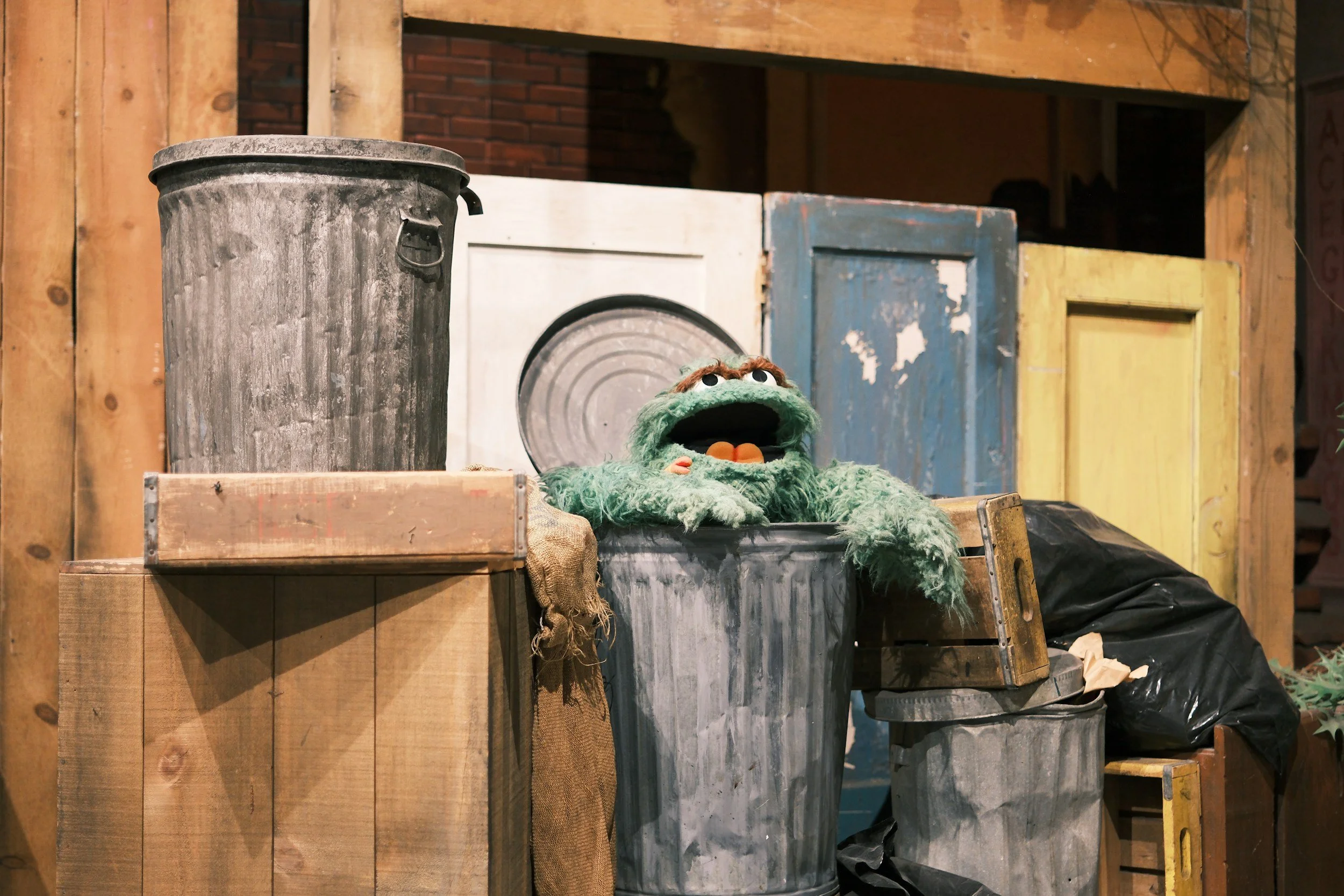
Sesame Street’s beloved Oscar the Grouch in the middle of his “I love trash” song.
The site we are on now is not only compact, but it is tricky to access. We needed to fit parking, common space, and landscaping while still leaving room for trash and recycling infrastructure for twelve households. Easy, you might say, “just use the driveway”
Allow us to introduce; the driveway - narrow, steep, and winding and very importantly it is shared with two neighboring properties. It is not exactly a welcoming corridor to line up 24 bins for each home, or allow for a large refuse truck to access site. We have been in the game long enough to know that if we are scratching our heads over a problem for too long, it’s time to call in the experts. Thompson Trash is our local service provider here in Newport Oregon and we can’t thank them enough for their time and advice. We work with them on other sites where our shared trash is in a large dumper and Thompson provides a “valet” service, where they take it from the enclosure to the truck. Essentially clearing up the curbside.
With our driveway though, wheeling dumpster-style bins down was not something they could do safely. We appreciated the honesty and are also a safety first company, so dumpsters were out.
We were quickly running out of options!
〰️
We were quickly running out of options! 〰️
We also wanted to minimize tenant frustration. Shared bins can become a source of low-grade community conflict, even within a singular household! We all know ( or have been) the person who doesn't break down their boxes, the neighbor who fills the recycling bin with non-recyclables. Our thinking was that the fewer bins shared, the greater chance of community cohesion. We also wanted to be conscious of common space. Nobody wants to sit outside and look at a row of trash cans.
We started asking our friends and family. We discussed with our site crew and site supervisors Mark and Josh. We talked to Thompson Trash at length not once, not twice. Look, let’s face it was a few times… Thank again, Victor.
The answer that emerged was almost disarmingly simple.

Our won’t be as colorful, but there will be at least 3x as many!
Twelve cans total = six trash, six recycling. Each of our six buildings houses two homes, and each pair of homes shares one trash bin and one recycling bin. That keeps the number of cans manageable without asking too many households to share the same container. Thompson Trash can service them safely. Tenants have a clear sense of ownership without being isolated.
For placement, we are building a trash enclosure along the north edge of our parking lot. Tucked away, it minimizes smell and visual clutter while keeping the common space and parking area open and functional. Of course, we are using part of our driveway to make it happen, but we luckily have plenty of street parking. Both in theory and in practice; for instance we needed to allocate 12 parking spots, but during the construction of these homes we regularly have more vehicles on site than that!
It is, as solutions go, a satisfying one. Elegant, even … if you will allow the word to apply to a trash enclosure.
It is the solutions that feel effortless and inevitable, you know, the ones that make you wonder why anyone considered anything else? Those are the design decisions that are almost never the ones that came easily. They are the product of asking the right people the right questions, sitting with the constraints long enough to understand them, and being willing to let the answer be simple when it turns out simple is correct.
Even when the subject is trash.
Thematic Credit to the fine folks at Sesame Street and to our original favorite neighbor, Mr. Rogers, and by extension the Public Broadcasting Station (PBS)
